

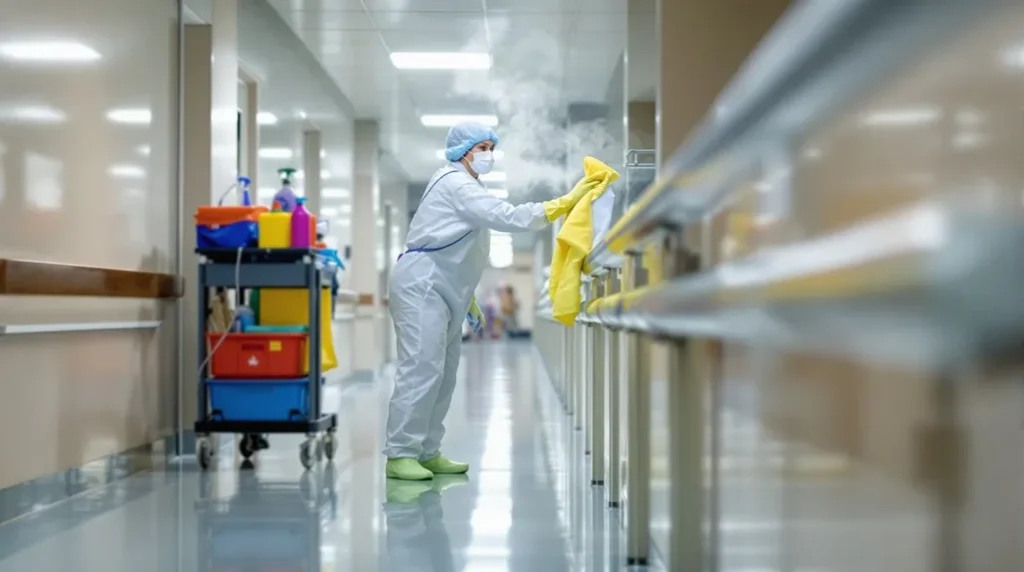
Professional medical cleaning prevents cross-contamination by targeting predictable pathogen transmission routes in healthcare facilities. You’ll find specialized teams using EPA-registered disinfectants at precise dilution ratios and with documented dwell times to eliminate dangerous organisms such as MRSA and C. difficile from high-risk touchpoints. These trained professionals focus on critical areas, including operating rooms, ICUs, and isolation wards, implementing protocols that can reduce healthcare-associated infections by 30-50%. The detailed strategies below explain how this protection works.
When pathogens spread through healthcare facilities, they follow predictable routes that you can identify and interrupt with proper cleaning protocols.
Direct contact transmission occurs when contaminated hands touch surfaces or patients. Droplet transmission spreads through respiratory secretions, landing on nearby surfaces. Airborne particles circulate through ventilation systems, settling on equipment and furnishings.
You’ll find high-risk touchpoints include doorknobs, bed rails, medical devices, and computer keyboards.
Healthcare workers’ uniforms and equipment become mobile carriers, transferring pathogens between rooms. Understanding these pathways helps you target cleaning efforts where they’re most effective, breaking the chain of infection before it spreads.
After identifying contamination pathways, you’ll need specialized disinfection protocols that go far beyond standard cleaning methods.
Hospital-grade disinfectants contain EPA-registered antimicrobial agents that eliminate pathogens within specific contact times. You’ll use quaternary ammonium compounds for general surfaces, bleach-based solutions for spore-forming bacteria, and alcohol-based products for equipment sterilization.
These protocols require precise dilution ratios, proper application techniques, and documented dwell times. You can’t substitute household cleaners—they lack the potency to destroy healthcare-associated pathogens like MRSA, C. difficile, and norovirus.
Professional-grade products guarantee complete pathogen elimination while meeting regulatory compliance standards for medical facilities.
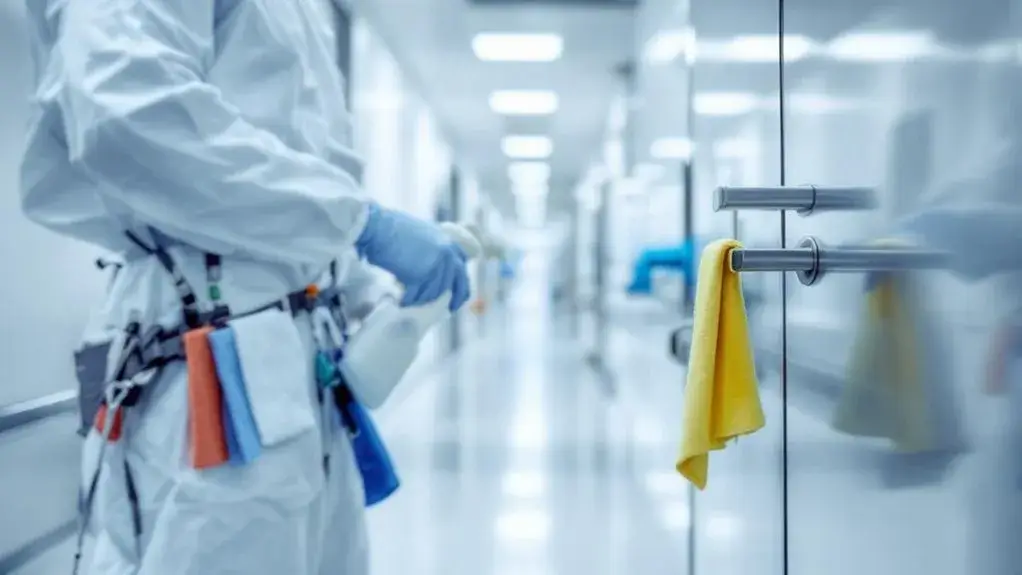
Certain medical environments require the highest level of professional cleaning expertise due to their elevated infection risk. You’ll find that operating rooms, intensive care units, and isolation wards require specialized attention due to vulnerable patient populations and complex procedures.
| Critical Area | Primary Risk Factor |
|---|---|
| Operating Rooms | Sterile field contamination |
| ICU Units | Immunocompromised patients |
| Emergency Departments | High patient turnover |
| Isolation Wards | Infectious disease spreads |
| Laboratory Spaces | Biological specimen exposure |
Professional cleaners focus on high-touch surfaces like door handles, bed rails, medical equipment controls, and workstations where pathogens accumulate most frequently.
Professional medical cleaning staff undergo rigorous training that far exceeds standard janitorial preparation.
You’re working with professionals who understand the unique challenges and stringent requirements of healthcare environments.
Their specialized education covers:
This comprehensive training ensures you receive cleaning services that protect patients, staff, and visitors from cross-contamination risks.
When healthcare facilities implement professional medical cleaning protocols, infection rates drop dramatically.
You’ll see measurable reductions in HAIs within months of upgrading your cleaning standards. Studies show that thorough disinfection programs can decrease healthcare-associated infections by 30-50%.
You’re targeting dangerous pathogens such as MRSA, C. difficile, and VRE that cause serious complications and prolonged hospital stays.
Your facility’s infection-control data will show improved patient outcomes when you invest in professional cleaning services.
You’ll reduce readmission rates, lower treatment costs, and enhance your facility’s reputation.
These quantifiable improvements demonstrate that proper medical cleaning isn’t just about cleanliness—it’s about saving lives and protecting your bottom line.
You’ll pay considerably more for professional medical cleaning than for regular services.
Medical cleaning typically costs 2-3 times more due to specialized training, medical-grade disinfectants, and strict compliance requirements.
While standard cleaning typically costs $0.10- $0.20 per square foot, medical facility cleaning ranges from $0.25- $0.50 per square foot.
You’re investing in specialized equipment, certified technicians, and rigorous protocols that meet healthcare standards and regulatory compliance.
You should schedule professional deep cleaning sessions monthly for most medical facilities, though high-traffic areas such as emergency rooms and surgical suites require weekly deep cleans.
You’ll want to increase frequency during flu season or disease outbreaks.
Don’t forget to schedule additional sessions after any infectious disease cases or contamination incidents.
Your facility’s size, patient volume, and specialized services will determine if you need more frequent cleaning to maintain proper infection control standards.
You’ll want to look for companies with OSHA certification for bloodborne pathogen training and hazardous material handling.
Seek out CIMS (Cleaning Industry Management Standard) certification, which demonstrates professional cleaning expertise.
ISSA certification shows staff training in proper techniques.
Also, verify they’re bonded, insured, and licensed in your state.
Check if technicians hold specialized healthcare cleaning certifications and understand HIPAA compliance requirements for medical environments.
Yes, you can schedule professional medical cleaning during regular business hours, but it depends on your facility’s needs.
Many cleaning companies offer flexible scheduling to work around patient appointments and staff workflows.
However, deep cleaning procedures, such as terminal room disinfection, typically require the space to be vacant.
You’ll want to discuss your specific requirements with the cleaning service to create a schedule that maintains operations while ensuring thorough sanitization.
Professional medical cleaning companies typically carry extensive insurance, including general liability, professional liability, workers’ compensation, and bonding coverage.
You’ll want to verify they maintain adequate coverage limits – usually $1-2 million minimum for general liability.
Many also carry specialized contamination and pollution liability insurance.
Always request current certificates of insurance before hiring, and confirm you’re named as an additional insured party for maximum protection during services.